Here's the situation I was trying to fix.
I don't hate meetings. I hate what happens after them. The scattered notes, the half-remembered decisions, the Slack message three days later asking "wait, did we agree to ship that or not?" The meeting itself is fine. The residue is the problem.
For years my system was a notes doc that grew into an unreadable wall. Highlights that meant something on Tuesday and nothing on Friday. Action items buried under discussion, and discussions that turned out to be the actual decisions.
So I built a system. Not a note-taking method, not a tool stack—a workflow with a specific output, a specific constraint, and a step that never gets automated.
Why Meeting Notes Fail
The failure isn't laziness. It's structural.
Notes Try to Do Three Jobs at Once
Most people take one stream of notes and expect it to serve three unrelated purposes:
Memory: what was said, in case I need it later.
Coordination: what we agreed to, who owns it, by when.
Narrative: the story of how we got here, for anyone who wasn't in the room.
One document can't do all three well. The moment you optimize for memory, coordination suffers. The moment you optimize for coordination, the narrative disappears. And so the notes end up mediocre at all three.
The Real Cost Shows Up Later
A bad notes system doesn't hurt in the meeting. It hurts a week later, when the decision resurfaces and nobody can reconstruct it. It hurts when a new person joins the project and there's no readable history. It hurts in the performance review, when you can't remember what you actually accomplished in Q2.
The cost is deferred, which is exactly why it stays broken.
AI Makes This Worse Before It Makes It Better
The default move is to record everything and let a tool summarize it. This produces a transcript-shaped summary that's long, generic, and organized by when things were said rather than what they mean. You've automated the wall of text, not solved the problem.
The fix isn't better summarization. It's deciding in advance what the output needs to be.
The Workflow
The core design decision: one meeting produces two artifacts, not one. They serve different readers and get built at different times.
Step 1: Define the Output Before the Meeting
Five minutes of setup, before you join. For any recurring meeting, answer:
Is this a decision meeting, a status meeting, or a working session? The output changes completely.
Decision meeting → a decision log.
Status meeting → a short written update.
Working session → a shared artifact plus open questions.
Who reads the output? Just attendees, or people who weren't there?
What's the one thing that must be captured no matter what?
For a standing meeting, you only do this once. Then it's the template.
Step 2: Take Sparse Live Notes
During the meeting, capture only three things:
Decisions made (the sentence, plus who made the call)
Action items (owner + verb + due date, nothing else)
Open questions (things that got parked, and by whom)
Everything else is optional. Resist the urge to transcribe discussion. If it matters later, it'll surface in the decision or the open question.
This is the discipline. Most note-taking fails because it tries to capture everything and therefore captures nothing usable.
Step 3: Build the Two Artifacts
Immediately after—within an hour, while memory is fresh:
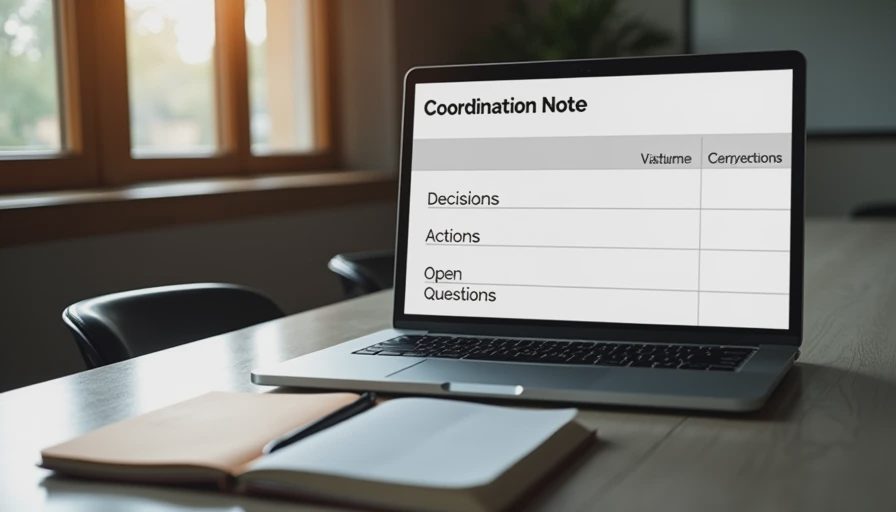
Artifact A: The Coordination Note
Short. Three sections: Decisions, Actions, Open Questions. This is what you send to attendees. It should take two minutes to read.
Artifact B: The Narrative Note
Longer, private, or shared only with a small group. This is the story: context, what was discussed, why the decision went the way it did, what's still uncertain. This is your memory. It's also what makes onboarding and reviews painless later.
This split is the whole idea. The coordination note serves other people now. The narrative note serves you and future colleagues later. Conflating them is what breaks the system.
Step 4: Where AI Actually Helps
Three specific jobs, and only three:
Structure the brain dump. After the meeting, dictate or type a messy stream of what happened. Ask the model to sort it into Decisions / Actions / Open Questions / Context. You're asking it to organize, not to decide.
Draft the coordination note from the narrative. Once the narrative exists, ask for the two-minute version. Compression, not creation.
Catch the missing owner. Ask the model to flag every action item that lacks an owner or a due date. This is the single most common failure in notes, and models are good at spotting it.
What AI should not do: decide what the decision was, infer what someone meant, or fill in a gap with a plausible guess. Those are the places where a confident wrong note is worse than no note.
Step 5: Run the "Worth Keeping?" Check
Monthly, review your narrative notes. For each recurring meeting, ask:
Did anyone ever read this?
Did it change a decision or prevent a mistake?
Would I miss it if it disappeared?
If the answer is no three times, stop taking narrative notes for that meeting. Keep the coordination note only. This is how the system stays lean instead of becoming another archive nobody opens.
The Before and After
Same meeting, two versions.
Before (the wall):
Discussed the Q3 roadmap. Team raised concerns about the migration timeline. Sarah mentioned the vendor contract. We went back and forth on the reporting dependency. Some agreement that we should probably push the launch. Action items to follow up.
After (the coordination note):
Decisions
Q3 launch moves from August 15 to September 5, to absorb the vendor migration. Sarah made the call.
Actions
Sarah: confirm vendor contract extension by Friday 8/2
Me: re-sequence reporting dependency, draft by Wed 7/31
Open questions
Does the September 5 date hold if the vendor slips again? Revisit 8/9.
The first one is a feeling. The second one is a record. And the second one took about ninety seconds longer to produce.
What Still Needs You
The parts of this system that can't be delegated:
Deciding what counts as a decision. Someone has to draw the line between "we talked about it" and "we decided." AI will guess, and it will be wrong.
Owning the ambiguous action. When an action item has no clear owner, someone has to assign it—and that someone is usually the person taking notes.
Judging what's sensitive. Not everything belongs in a note that circulates. What gets written down, and where, is a judgment call with real consequences.
Knowing when to stop. Some meetings don't need notes at all. Recognizing which is a skill, not a rule.
The model organizes. You decide what's true, who owns it, and whether it should exist in writing at all.
The One-Meeting Version
If you want to test this before committing:
Pick your most recurring, most annoying meeting.
Define the output type before the next one.
Take sparse notes—decisions, actions, open questions only.
Write the two artifacts within an hour of the meeting.
Send only the coordination note. See if anyone misses the wall.
One meeting. If the coordination note gets read and the narrative note never does, you've learned something important about which artifact actually matters for that meeting.
The point isn't perfect notes. It's that the meeting's value survives past the hour it happened in—and that the system pays for its own maintenance.
Better work first. More options next.
Make the workflow earn its place.




No feedback yet — submit the first.